While Labuan Bajo and the Komodo National Park draw the headlines, the real heart of Flores sits inland, up where the road climbs into cloud and Manggarai villages perch on ridgelines that catch the last light before dark. An overland crossing of this island is one of the great road trips in Indonesia — not because any one stop out-dazzles Komodo, but because of how much shifts under your feet as you go: the architecture, the language, the crops on roadside stalls, the temperature at night. You leave the coast as a beach destination and arrive at the other end having seen a completely different Flores.
This guide strings together the interior's essential stops in the order you'll actually drive them, heading east from Labuan Bajo toward Ende or Maumere, with realistic driving times, what each stop is actually for, and the planning details that make the difference between a trip that flows and one that turns into a week of sore backs and missed sunrises.
Full Route
Labuan Bajo → Maumere, ~600 km
Ideal Trip Length
5-7 days
Road Type
Paved, mountainous, sharp bends
Highest Point
Kelimutu, ~1,600 m
Ruteng: Manggarai Highlands and the Spiderweb Rice Fields
The first proper stop east of Labuan Bajo is Ruteng, the highland capital of Manggarai, roughly 3 to 4 hours by road. The drive alone is worth the trip — the coastal heat gives way gradually to pine-covered hills, and by the time you roll into town the air has a genuine chill to it, especially after dark.
Ruteng itself is a working highland town rather than a tourist stop: a central market, a cathedral, motorbikes weaving between produce trucks. But just outside town, in the village of Cara near Cancar, is one of the most photographed farming landscapes in Indonesia — the Lingko spiderweb rice fields. Manggarai communities divide communal land using a customary system where fields radiate out from a central point like spokes on a wheel, and from the viewpoint above Cara the whole pattern reads as an enormous, symmetrical web cut into the hillside. Go in the late morning when the light is even and the terraces are green; a small entry contribution to the local farmers is customary and worth paying without haggling.
If you have an extra hour, Liang Bua cave north of Ruteng is where the fossils of Homo floresiensis — the so-called "hobbit" — were discovered in 2003. It's a quiet, unassuming site, more interesting for what it represents than for any dramatic scenery, but worth it for anyone curious about the science.
The Wae Rebo Detour
From Ruteng, most travelers branch south toward Wae Rebo, the cone-roofed Manggarai village that has become the emotional centerpiece of any Flores overland trip. It's a genuine detour, not a quick stop: figure 2 to 3 hours of driving from Ruteng to Denge, the last village with road access, followed by a trek of roughly 2 to 4 hours uphill through mountain forest to reach the village itself at around 1,200 meters.
Because of the trekking time and the fact that most visitors stay overnight in one of the seven traditional Mbaru Niang houses, Wae Rebo effectively costs a full extra day compared with a route that skips it. It is, for almost everyone who makes the climb, the single most memorable stop on the island — but budget for it honestly rather than trying to squeeze it into a half-day. If Wae Rebo is the priority for your trip, it's worth reading a dedicated guide to the trek itself before you commit to the itinerary below.
Bajawa: Ngada Culture, Traditional Villages, and Hot Springs
Back on the main road, Bajawa sits roughly 5 to 6 hours east of Ruteng (less if you're coming directly rather than via the Wae Rebo detour), in Ngada territory at the foot of the near-perfect volcanic cone of Gunung Inerie. This is highland Flores at its most atmospheric — cool nights, misty mornings, and some of the best-preserved traditional villages on the island.
Bena, about 45 minutes from Bajawa town, is the one most visitors prioritize: a megalithic village of stone-roofed houses arranged in tiers down a ridge, with megalithic stone structures and ancestor shrines standing in the central courtyard. It's still inhabited, not a museum piece, and the combination of animist tradition and Catholic practice that defines Ngada culture is visible everywhere, from the crosses on rooftops to the stone altars beside them. Nearby villages like Luba and Belaraghi see far fewer visitors and are worth the short detour if you want a quieter version of the same experience.
Bajawa is also the place to warm up, literally. The Soa hot springs (also called Mengeruda), about 30 minutes outside town, channel volcanically heated water into a series of natural pools set beside a small waterfall — a genuinely good way to loosen up after a few days of winding mountain roads.
Kelimutu: The Tri-Colored Crater Lakes
From Bajawa, it's another 4 to 5 hours to Moni, the small village that serves as base camp for Kelimutu, and this is the stretch most people plan their whole itinerary around. The routine is simple but non-negotiable if you want the classic experience: leave Moni around 4 a.m. so you're at the crater rim before sunrise.
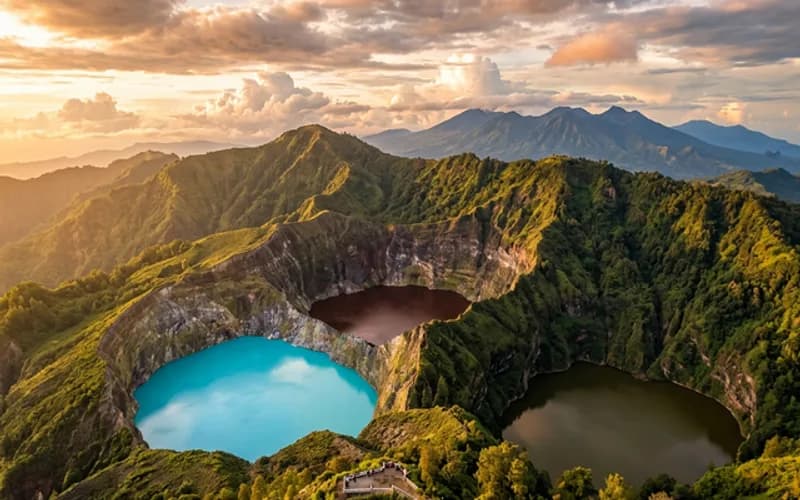
Kelimutu has three volcanic crater lakes sitting side by side at the summit, and their colors shift over months and years — currently ranging through combinations of turquoise, near-black, and rust-brown, driven by changing mineral and gas activity beneath the surface. Local Lio communities regard the lakes as a resting place for departed souls, and the atmosphere at dawn, with mist pooling in the craters and the sky turning color behind them, makes that belief easy to understand even as an outsider. Bring a jacket — at nearly 1,600 meters before sunrise, it is genuinely cold, colder than almost anywhere else on this itinerary.
Ende or Maumere: Journey's End
From Moni, the road splits toward two possible endpoints. Ende, about 1.5 to 2 hours south, is where Sukarno spent part of his Dutch-era exile — his house is preserved as a small museum — and the town also has striking black-and-white sand beaches nearby. It has a domestic airport with regular connections back to Bali or onward.
Maumere, roughly 4 hours from Moni, is the larger of the two and the better choice if diving is part of your plan; the reefs off nearby Maumere Bay and the Alor-Flores corridor are excellent and less crowded than Komodo's. Maumere also has more frequent flights, which matters if you're trying to fly out on a specific date rather than working around a thinner schedule.
Self-Drive or Hire a Car and Driver?
The Trans-Flores highway is fully paved along this entire route, but "paved" doesn't mean easy. It is a genuinely demanding road — constant switchbacks, blind bends around hillsides, occasional landslide debris or roadwork after heavy rain, and long stretches with no fuel, phone signal, or roadside assistance. Locals sometimes call it the road of a thousand bends, and that's not much of an exaggeration.
Hiring a car with a local driver is, for the large majority of travelers, the better decision, not just the easier one. A driver who knows the route understands which sections turn treacherous in rain, where to stop for food and fuel, and how to pace the day so you're not still navigating hairpin turns after dark. Self-driving a rental car is possible if you're an experienced mountain driver comfortable with manual transmission and unmarked roads, but it adds real risk and takes attention away from the scenery, which is rather the point of the trip. Motorbiking the route is popular with backpackers but should only be attempted by confident, experienced riders — the combination of altitude, cold, fatigue, and mountain traffic is unforgiving.
One-way logistics are worth planning early. Most travelers fly into Labuan Bajo and out of Ende or Maumere (or vice versa) rather than driving the whole route round-trip, which saves several days. If you go this way, book your driver or tour operator for a one-way overland transfer specifically — not every operator offers this, and it's worth confirming before you commit to flights on both ends.
Suggested Pacing for 5 to 7 Days
- Day 1: Labuan Bajo to Ruteng, with a stop at the Cancar spiderweb rice fields en route.
- Day 2: Ruteng to Denge, trek up to Wae Rebo, overnight in the village.
- Day 3: Trek back down to Denge, drive on to Bajawa.
- Day 4: Bajawa: Bena traditional village in the morning, Soa hot springs in the afternoon.
- Day 5: Bajawa to Moni, resting up ahead of an early start.
- Day 6: Sunrise at Kelimutu, then drive on to Ende or Maumere.
- Day 7: Buffer day or departure by flight.
If you're working with only 5 days, the version most people cut is the Wae Rebo overnight, which turns this into a faster but noticeably less immersive trip. If Wae Rebo is non-negotiable, 7 days is the more comfortable target.
Packing and Prep for the Highlands
Flores markets itself on the beach, so first-timers routinely underpack for the interior. Nights in Ruteng, Wae Rebo, Bajawa, and especially at the Kelimutu crater rim before sunrise all run cold by tropical standards, and a t-shirt is not going to cut it standing at altitude in the dark. Layers matter more than any single heavy item — a base layer, a light fleece or jumper, and a packable rain jacket cover almost every scenario you'll hit.
- Pack for both heat and cold — shorts and sandals for the coast, closed shoes and a warm layer for the highlands.
- A rain jacket is essential regardless of season; mountain weather changes fast and without much warning.
- Motion sickness medication is worth having even if you don't normally need it — the switchback roads catch people off guard.
- Carry cash. ATMs thin out badly once you leave Ruteng, and small towns like Moni or Bajawa may have limited or unreliable machines.
- Download offline maps and save your driver's or guide's number before you lose signal in the mountains.
- A power bank is genuinely useful; charging opportunities in villages and smaller guesthouses aren't guaranteed.
Book your driver before you land
Good Trans-Flores drivers get booked out well ahead during peak season (roughly May through September). Arrange your car and driver, or your full overland tour, before you arrive in Labuan Bajo rather than trying to find one on the ground.