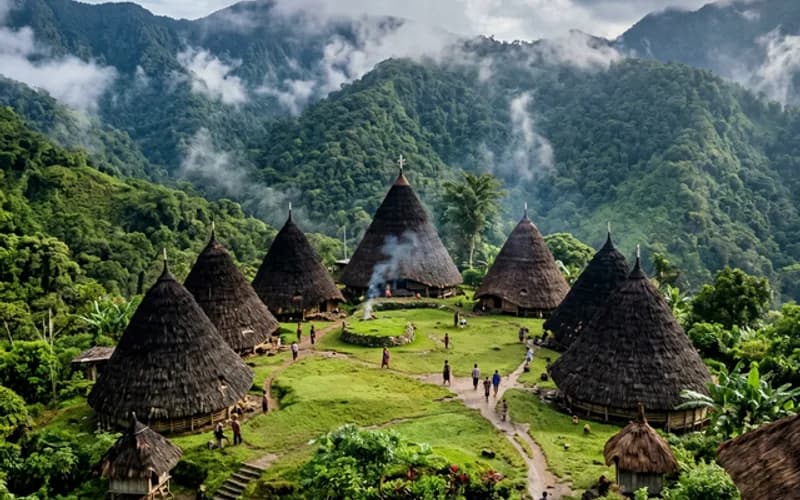
Above the clouds of West Manggarai, seven cone-shaped roofs rise out of the mist like something from another century. Wae Rebo is not a place you simply drive up to — it is a place you earn, one uphill step at a time.
That is exactly what makes reaching it feel so quietly extraordinary.
Drive from Labuan Bajo
110-150 km · 4-5 hrs
Trek Distance
5-8 km one way
Trekking Time
2-4 hrs uphill
Elevation
~1,200 m altitude
The Road to Denge
Before any hiking begins, there is a long, winding drive. From Labuan Bajo, it takes roughly 110 to 150 kilometers and 4 to 5 hours by car to reach Denge, the last village with road access and the official starting point of the trek.
The route curves through Manggarai's hill country, past rice terraces and small roadside villages, and is usually broken up with a stop for lunch. Most travelers begin the drive early in the morning to leave enough daylight for the hike ahead. Some itineraries split the journey by overnighting in Denge or a nearby homestay the night before, starting the trek fresh the next morning rather than arriving already tired from a full day of driving — worth asking your operator about if an early-morning trek start matters to you.
The Trek Itself
From Denge, the trail to Wae Rebo covers about 5 to 8 kilometers and climbs roughly 600 to 750 meters through dense mountain forest. It is a dirt-and-root path, not a technical climb — no ropes or exposed ledges — but it is a genuine, sweaty effort.
Reasonably fit hikers usually reach the village in 2 to 3 hours; families, or anyone stopping often for photos, should plan closer to 4. The trail turns slick after rain, so proper trekking shoes matter more here than almost anywhere else in Flores. The path passes through several distinct sections — an initial stretch of farmland and coffee gardens, then increasingly dense forest canopy that blocks direct sun (a small mercy on a humid day), with a handful of resting shelters spaced along the way where porters and guides typically pause.
You don't need technical hiking experience for Wae Rebo, but you do need a reasonable baseline of fitness — the sustained, steady climb is more demanding than its distance alone suggests, and there's no vehicle access or shortcut partway up if you change your mind. If you have any concerns about your fitness level, mention it to your guide beforehand; the pace can be adjusted, and porters can be arranged to carry your bag for the climb.
Arriving at Wae Rebo
Then the forest opens, and the effort makes complete sense. Seven traditional Mbaru Niang houses stand in a circle on a grassy saddle at roughly 1,200 meters, their thatched roofs sweeping almost to the ground in the distinctive cone shape unique to this one Manggarai village.
The number seven isn't incidental — in Manggarai cosmology, seven represents the seven ancestors believed to have founded the village, and the community has maintained exactly seven houses for generations, rebuilding each Mbaru Niang from natural materials as it ages. Each house is a communal structure shared by several families, rising through several internal levels used historically for living space, food storage, and ancestral offerings, all built without nails, using timber, rattan bindings, and layered thatch that can take a dedicated construction team weeks to complete when a house needs replacing.
Guests are welcomed with a short traditional ceremony before being invited to stay the night. This isn't a formality for show — it's a genuine request for permission, rooted in the belief that visitors should be introduced to the village's ancestral spirits before staying under its roofs. A village elder typically leads the ceremony, which involves a brief prayer and an offering, and guides usually explain what's happening as it unfolds so visitors understand the significance rather than just observing it. It's considered respectful to stay quiet and attentive during this part, even if you don't understand the language.
A Night in the Communal House
Overnight accommodation is simple and shared: guests sleep on woven mats laid across the wooden floor of the main house, generally with bedding or a thin mattress provided, and a shared, communal atmosphere rather than private rooms. There's no electricity in the conventional sense — some houses have limited solar power for basic lighting in the evening, but don't expect to charge multiple devices, and a headlamp or torch is genuinely useful once the sun goes down.
Meals are prepared and shared communally, often featuring vegetables and produce grown right in the village, along with the coffee Wae Rebo has become quietly known for — Manggarai arabica grown on the surrounding slopes, roasted and brewed locally. It's a good idea to try a cup while you're there and, if you like it, ask about buying some beans to take home; it supports the village directly and it's a genuinely nice souvenir. Evenings tend to be early and quiet: without electricity or phone signal to speak of, most visitors are in bed not long after dinner, which turns out to be one of the trip's better surprises rather than a hardship.
Weather, Altitude, and the Best Season to Go
At roughly 1,200 meters, Wae Rebo runs noticeably cooler than the coast — evenings and early mornings can feel genuinely cold, especially once the sun drops, so warmer layers matter more than most travelers expect after days in Labuan Bajo's heat. Cloud and mist are common, particularly in the afternoon, which is part of what gives the village its atmosphere but also means visibility and photo conditions can shift quickly.
The dry season, roughly April through October, is the more reliable window for trekking, with firmer trail conditions and a lower chance of the heavy rain that turns the path to mud. The wet season, especially December through February, brings a real risk of slippery, occasionally hazardous sections and reduced visibility, though the forest is at its greenest during these months if you don't mind the extra caution required underfoot. Whatever the season, mountain weather here can change within an hour, so packing for rain is sensible even in the dry months.
Respectful-Visitor Etiquette
Wae Rebo remains a living, working village, not a museum, and visitors are guests in the truest sense. Photography is generally welcomed, but it's good practice to ask before photographing individual villagers up close, and to be mindful during the welcome ceremony rather than treating it as a photo opportunity first. Modest dress is appreciated, loud or disruptive behavior is not, and it's worth remembering that the community has chosen to open their home to outside visitors — a choice that comes with an expectation of respect in return.
Coffee, incidentally, is a good entry point for a respectful conversation with villagers if your guide can help translate — the community's growing reputation for its arabica has become a genuine source of local pride, alongside their role as custodians of one of Flores's most distinctive architectural traditions.
Practical Tips
- Wear proper trekking shoes with grip — sandals are not enough on the muddy sections.
- Bring a light rain jacket; mountain weather changes fast.
- Carry your own drinking water; there are limited refill points along the trail.
- A local guide is required and can be arranged in Denge or booked in advance.
- Pack a warm layer for the evening — it gets genuinely cold at altitude after dark.
- Bring a headlamp or torch; there is little to no electric lighting after dark.
- Most visitors stay one night in the village before trekking back down the next morning.
Bring small cash and an open mind
There are no ATMs or shops once you leave Denge, so bring enough small-denomination cash for the village contribution, any coffee you want to buy, and tips for your guide and porter. And go in expecting a genuinely simple night — no power outlets, no hot showers — it's part of what makes the experience worthwhile.